
Mon-Fri: from 9 am to 6 pm


Mon-Fri: from 9 am to 6 pm

DEMUS is an agricultural tillage technique that incorporates the experience of the world's leading manufacturers.

Rotary hoe is used mainly for destruction of the soil crust (aeration) and mechanical weed control, but it is also used to dry the soil in the spring, so that there is an opportunity to carry out sowing earlier.
Due to its small size, such a hoe is ideal for breeding farms that want to use a quality product at moderate costs.

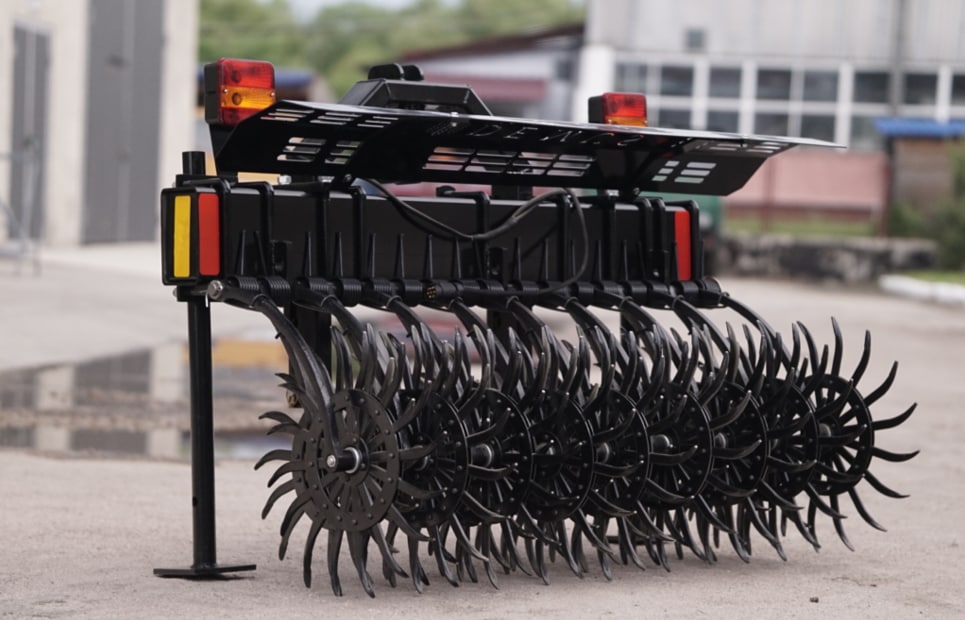

The shape and angle of the tooth of the impeller is of great importance. Thanks to the angle, the tooth enters the soil at a right angle, and at the exit, it creates a micro-explosion during movement.

Dimension lights allow safe movement on public roads in the dark.

All Demus rotary harrows are equipped with a protective shield that protects the tractor cab during operation from plant residues, lumps, etc. getting into it.

🌱 1. Crust destruction and improved soil aeration
The working elements of the harrow break up the surface crust, which prevents seedlings from emerging properly.
This improves oxygen (O₂) access to plant roots and stimulates plant growth.
💧 2. Moisture retention
Loosening the topsoil reduces moisture (H₂O) evaporation.
As a result, vital moisture is preserved, supporting crop growth.
🌿 3. Effective weed control
The rotary harrow destroys small weed seedlings at an early growth stage.
This reduces competition for light, water, and nutrients, allowing the crop to thrive.
🚜 4. High-speed operation
The implement can work at speeds up to 20 km/h, ensuring high productivity and time efficiency.
🌾 5. Versatility
It can be used at various stages of crop development — from sprouting to more mature plants — without damaging them.
In summary, the rotary harrow is an effective tool for mechanical crop care that offers:
chemical-free weed control,
better aeration and moisture conservation,
protection and support for seedlings,
savings in time and resources.
